Local SEO for landscapers in Dallas-Fort Worth comes down to four jobs: a complete Google Business Profile, a real page for each city you want, a steady flow of reviews, and matching business details across the web. Google ranks local results on relevance, distance and prominence. Its help page on local ranking also says there is no way to pay for a better local ranking.
That matters here because DFW is not one market. A homeowner in Keller and a homeowner in McKinney see different results, even for the same search. A crew based in Mansfield will not show up everywhere just because its website says "serving the Metroplex."
North Texas also adds details most national guides skip. Texas irrigation license rules reach your ads and your trucks, and Fort Worth's watering rules shape what customers ask in summer. This guide gives you the order of work, the city-by-city thinking, and the local items worth putting on your site.
Why DFW Is Not One Local Search Market
DFW behaves like a group of small local markets, because distance is one of Google's three local ranking factors. Google weighs how far each business is from the person searching, so your position changes as the searcher moves.
That is why a blanket "DFW landscaper" plan stalls. Decide where you want to win first. Group the cities by where your crews already work, then go after one group at a time.
| Area (main county) | Cities |
|---|
| West side (Tarrant) | Fort Worth, Arlington, Mansfield, Keller, North Richland Hills, Southlake |
| Dallas side (Dallas) | Dallas, Irving, Garland, Mesquite, Richardson, Grand Prairie |
| North (Collin) | Plano, Frisco, McKinney, Allen |
| Northwest (Denton) | Lewisville, Flower Mound |
Several of these cities cross a county line, so treat the groups as a planning tool. Start with the group closest to your yard. Distance helps you there, and shorter drives protect your margin. The full list of cities sits on the Dallas-Fort Worth page.
What DFW Homeowners Actually Search
Most landscaping searches pair a service with a city, or a service with "near me." Someone with a dead lawn rarely types "landscaper." They type the problem they have and the place they live.
- Service plus city: "sod installation Keller," "landscape lighting Frisco," "sprinkler repair Arlington"
- Grass type: "St. Augustine sod Southlake," "Bermuda lawn care Plano"
- Problem: "drainage for clay soil Fort Worth," "dead grass after freeze Dallas"
- Commercial: "HOA landscaping Allen," "commercial landscape maintenance Irving"
These show the search pattern, not volume numbers. Your own Search Console data shows which terms already reach you. Use those words in your page titles, your headings and your Google services list.
Your Google Business Profile Comes First
Your Google Business Profile comes first because it is what appears in the map results. Google's advice is plain: verify the business, keep your details complete, answer reviews, and add photos.
Here is the setup for a DFW crew:
- Verify the profile and pick the category that fits your main work, such as Landscaper.
- Remove your address if customers do not come to it. Google's service area page tells businesses to do this.
- Set your service areas. Google allows up to 20, and the whole area should sit within about 2 hours of driving from your base.
- List services by name: sod installation, drip irrigation, French drains, retaining walls, landscape lighting. List only what you sell.
- Upload photos from real jobs. A stone patio in Southlake says more than a stock photo.
- Keep hours current, including holidays and weather closures.
- Post one update a week about a job, a season or a service. This guide to Google Business Profile posts covers what to write.
Twenty service areas sounds like plenty until you list DFW suburbs. Choose the cities you want work from, not every city you could reach. Adding a city also does not cancel distance. A service area tells customers where you go. Google's help page makes no promise that it earns a ranking there.
Want More DFW Landscaping Calls From Google?
Kiss My Grass Social has worked with landscapers, pest control companies, and tree services in the Tri-State area and the Dallas-Fort Worth market for 10 years. Get in touch to talk about your business.
Email: [email protected] | kissmygrasssocial.com
Veteran-owned and family-owned.
City Pages Reach the Suburbs Your Profile Cannot
A city page gives Google and customers a reason to connect you with a suburb outside your home base. Your profile sends the map signal, and the page explains why you belong there.
A useful city page has these parts:
- The services you sell in that city, with job photos from that city
- A short note on real conditions, such as heavy clay soil, HOA approval or mature shade trees
- Reviews from customers there, quoted word for word
- Neighborhoods you have worked in, named only with permission
- A tap-to-call phone number and a short form
Do not swap the city name across one template. Google's spam policies call that kind of near-duplicate page doorway abuse, and customers can spot it too. This guide to location pages that rank covers the structure.
Start with three to five cities where you already have jobs and photos. Add more as you collect proof. Check each page on a phone, because slow mobile pages lose people standing in their own yard. A site built for your trade makes all of this easier, and that is the idea behind landscaping web design done from scratch.
Reviews Build the Prominence Google Looks For
Reviews feed prominence, the third of Google's local factors. Google names review count as a prominence signal, and it tells owners to answer reviews and gather more.
- Ask within a day of finishing the job, while the yard still looks fresh.
- Text a direct review link so it opens in one tap.
- Ask customers to describe the work in their own words. Never write it for them.
- Reply to every review, good or bad.
- Never pay for a review or trade a discount for one. Google's review policy counts that as an incentivized review.
Steady beats a burst. Fresh reviews tell a homeowner you are still working, and a review that mentions "sod in Keller" speaks straight to the next person in Keller. Our guide to the Google Local Pack goes further on map rankings.
Citations and Links Back Up Everything Else
Citations are listings of your business name, address and phone across the web. They should match your Google profile exactly, because mismatched details confuse customers and make your business harder to verify.
Start with Apple Business Connect, Bing Places, Yelp, the Better Business Bureau, Angi, Nextdoor and Facebook. Use one business name and one phone number everywhere.
Google also counts links to your site as a prominence signal. Good DFW sources include your city chamber of commerce, the Texas Nursery & Landscape Association and the Texas Turf Irrigation Association. Suppliers and youth sports teams you sponsor can link to you too. One real local link is worth more than a stack of paid directory listings.
Texas License Details Belong on Your Website
If you sell irrigation work in Texas, your license number belongs in your advertising. TCEQ's notice says anyone who conducts or advertises landscape irrigation services in Texas must hold a license.
Texas rule 30 TAC 344.70 requires the number on any irrigation advertisement, in any medium. Vehicles used for irrigation work must show it on both sides, in block letters at least two inches high. If an ad names someone other than the licensed irrigator, it must also name that irrigator and show the number.
Put the number in your site footer and on your irrigation page. It keeps your ads in line, and it shows a homeowner you are legitimate. This is general information, not legal advice, so confirm the current rule with TCEQ.
Seasonal Pages Match How North Texas Lawns Behave
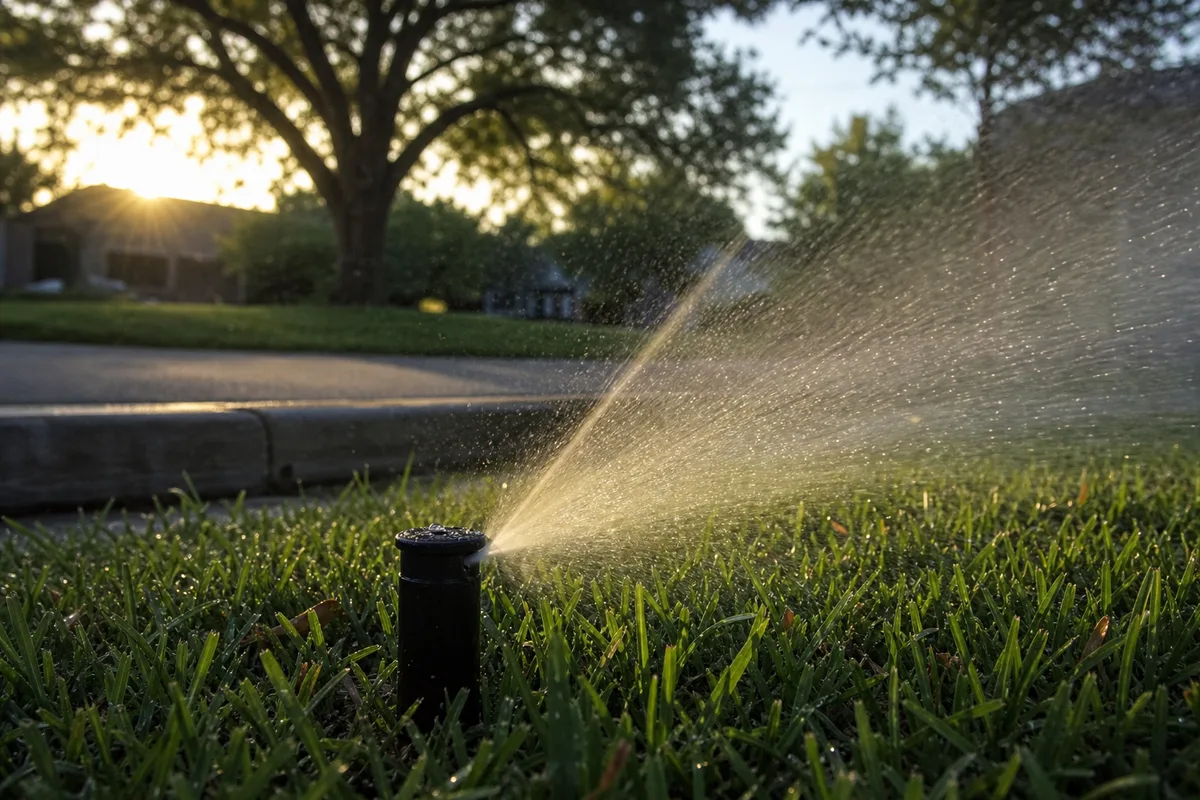
Seasonal content works in DFW because customer questions change with the weather and the water rules. Fort Worth, for example, limits sprinklers to two set days a week all year and bans them from 10 a.m. to 6 p.m.
What should a DFW landscaper publish each season?
| Season | Customer question | Page or post idea |
|---|
| Winter | Did the freeze kill my shrubs? | Freeze damage checks, dormant pruning, hardscape projects |
| Spring | When should weed control go down? | Spring cleanup, sod installation, pre-emergent timing |
| Summer | Why is my lawn brown on a twice-a-week schedule? | Watering rules by city, irrigation tune-ups, tough plants |
| Fall | Should I winterize my sprinklers? | Leaf cleanup, fall planting, sprinkler winterizing |
Water rules are set city by city, so check each one before you publish. For more on timing, see seasonal landscaping marketing.
A 30-Day Order of Work for DFW Landscapers
Work in this order, because each step supports the next. Your profile goes first, and your proof builds from there.
- Week 1: verify and complete your profile, remove your address if needed, and set service areas.
- Week 2: match your name, address and phone on the citation sites above.
- Week 3: publish your first city page for the group nearest your yard, and add your license number.
- Week 4: start the review text on every finished job and post your first weekly update.
After that, add one city page or seasonal post a month. Track calls and form requests by city, not just rankings. If you want help with the setup, our local SEO service covers this work.
Local SEO Questions From DFW Landscapers
Here are short answers to common questions about showing up on Google in Dallas-Fort Worth.
How long does local SEO take for a DFW landscaper?
There is no fixed timeline, and anyone who promises one is guessing. Profile fixes can show up quickly, while city pages and reviews build over months. Competition also varies from one suburb to the next. Track calls by city each month to see real progress.
Do I need an office in every DFW city?
No. Service-area businesses can list the cities they serve without an address in each one. Google's guidelines do not allow a mailbox or virtual office as a business location, so skip those. Use service areas on your profile and real city pages on your website instead.
Can I pay Google to rank higher in the map results?
No. Google says there is no way to request or pay for a better local ranking. Google Ads and Local Services Ads buy a paid placement marked as sponsored, and that is separate from free map results. You can run both, but fix your free listing first.
Should I target all of Dallas-Fort Worth at once?
No. Start with the cities nearest your yard, where distance already helps you and shorter drives protect your margin. Add a new group once those pages have real photos and reviews behind them. Spreading thin across every suburb usually leaves every page weak.
Get Your Landscaping Business Found Across DFW
Kiss My Grass Social has worked with landscapers, pest control companies, and tree services in the Tri-State area and the Dallas-Fort Worth market for 10 years. Get in touch to talk about your business.
Email: [email protected] | kissmygrasssocial.com
Get a Quote →