
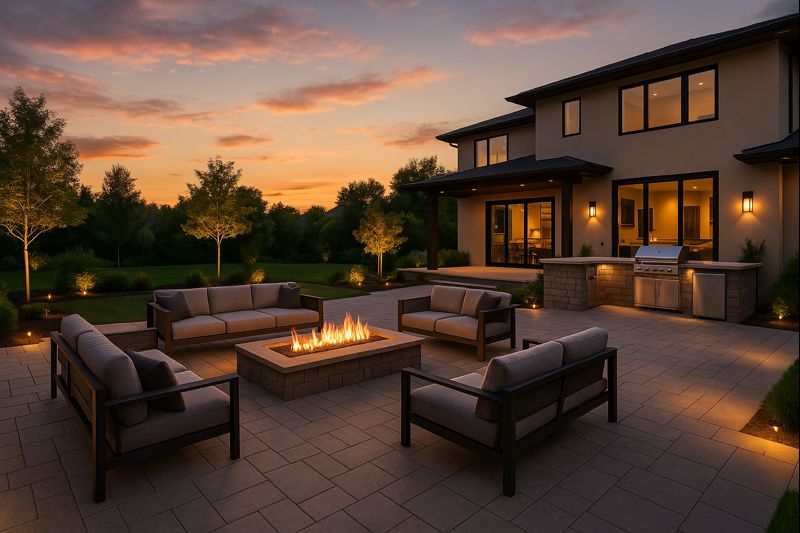
High-ticket hardscape clients don’t shop the way “basic service” clients do.
A homeowner looking for weekly mowing might scroll Google, compare a couple of prices, and book quickly. A homeowner planning a $35,000 patio with a gas fire feature, lighting, drainage corrections, and a built-in kitchen is doing a completely different kind of evaluation. They’re comparing craftsmanship, credibility, design taste, communication style, process, timeline, warranty, and the likelihood that the contractor will actually deliver what’s promised.
Your website is the first place high-value prospects “audit” you, even if they found you through referrals, Houzz, Instagram, a neighborhood group, or a builder partner. If your site looks like it was built for discount jobs, you’ll attract the wrong leads, and the right leads will quietly move on.
This guide walks through how to prepare your site to attract and convert premium hardscape projects without wasting time on low-budget inquiries.
What High-Ticket Hardscape Clients Actually Want From Your Website
Before you edit a headline or swap photos, it helps to understand the decision-making lens high-ticket prospects bring to the table.
High-end outdoor living buyers typically want:
- Confidence: proof you deliver complex projects cleanly and professionally
- Clarity: what you do, where you work, and what the process looks like
- Taste alignment: design style that matches their home and expectations
- Risk reduction: warranties, licensing/insurance cues, safety and permitting awareness
- A firm next step: a smooth consultation process that feels premium
When your website delivers these signals clearly, your leads improve immediately, even before you change your marketing.
Step 1: Position Your Brand Like a Premium Outdoor Living Builder
If your homepage (or header) says “Landscaping, Lawn Care, and Hardscapes,” you’re positioning yourself as a generalist. High-ticket buyers want specialists.
Make hardscapes the hero
If high-ticket hardscapes are the goal, your top navigation, homepage sections, and “above the fold” message should prioritize:
- patios and pavers
- outdoor kitchens
- retaining walls and drainage solutions
- fire features
- pergolas and shade structures
- outdoor lighting integration
- pool surrounds and premium hardscape upgrades
This doesn’t mean you can’t offer other services. It means your website needs to lead with the work you want more of.
Update your language (and your pricing posture)
Premium prospects respond to language that communicates outcomes, not chores.
Swap:
- “Affordable patio installation”
For:
- “Custom patio design + build”
- “Outdoor living spaces built to last”
- “Architectural paver and stonework for luxury homes”
Avoid “cheap,” “budget,” and “lowest price.” If you want premium work, your copy must sound like premium work.
Step 2: Build a Portfolio That Sells (Not Just a Gallery)
A folder of random before/after photos won’t close $40,000+ projects. High-ticket hardscape clients want to see:
- craftsmanship up close
- design intent
- material quality
- scale and context
- consistency across multiple projects
Create project pages, not just photo grids
Your portfolio should include individual project pages (or case studies) with:
- a short project summary (goal + scope)
- material callouts (pavers, coping, stone, grout, drainage solutions)
- 10–25 high-quality images (wide shots + detail shots)
- optional: a simple “before” photo when it helps tell the story
- a “what we solved” section (grading, drainage, slope, settling, access challenges)
- a “timeline + process” section
Even if you don’t share exact pricing, you can share:
- “Investment range” (example: “Most projects like this fall in the $25k–$45k range.”)
- “Scope notes” (“Included demolition, base rebuild, drainage corrections, and premium lighting.”)
The goal is to help prospects self-qualify while seeing the level of work you do.
Upgrade your photography standards
If you want high-ticket clients, smartphone photos taken at noon with clutter in the background will hold you back.
Do this instead:
- take photos during golden hour (early morning or evening)
- stage the space (remove hoses, toys, bins, and random furniture)
- capture straight lines (avoid tilted horizons)
- include at least 3 detail shots: edges, joints, caps, transitions, steps, lighting
- show the hardscape “working” (fire on, lights on, seating arranged)
A premium website doesn’t require “fancy.” It requires visual proof that you operate at a premium level.
Step 3: Create a Premium Service Page Structure (Built for Conversions)
High-ticket clients don’t want to click around trying to figure out what you actually do. They want immediate clarity.
For each core service, build a dedicated page with this structure:
H2: What the service is (and who it’s for)
Example: “Custom Paver Patios for Outdoor Living”
Include:
- what makes your patios different
- typical goals (entertaining, durability, drainage, style match)
- property types you serve (higher-end neighborhoods, new builds, older homes needing grading correction)
H2: Your process (how a project actually moves forward)
Premium buyers are process buyers. Show a simple, confident sequence:
- Discovery call / initial screening
- Design consultation (and whether design is paid)
- Site measurement + utilities/permitting considerations
- Material selection + renderings (if offered)
- Proposal and timeline
- Build phase (communication cadence)
- Walkthrough + warranty handoff
If you want fewer tire-kickers, be transparent.
H2: Materials + craftsmanship signals
Call out what premium clients care about:
- base depth and compaction practices
- drainage corrections and grading awareness
- jointing sand quality and sealing guidance
- edge restraint standards
- equipment and crew standards
You don’t need to overwhelm the page with technical jargon. You need enough detail to communicate, “We know what we’re doing, and we do it correctly.”
H2: Proof and reassurance
Add:
- 3–6 testimonials specific to that service
- 6–12 images
- links to related project pages
- warranty language and licensing/insurance cues
If your service pages feel thin, generic, or “copy/paste,” high-ticket prospects will assume your work is the same.
Step 4: Add Pricing Signals Without Posting “One Price”
Premium leads improve when you stop acting like price is a secret.
You do not need to publish a fixed price list for custom hardscapes. You do need to set expectations.
Use investment ranges
Example:
- “Most paver patio projects start at $18,000+ depending on size, access, and materials.”
- “Outdoor kitchens typically range from $12,000–$30,000+ depending on appliances and utilities.”
This does two critical jobs:
- filters out low-budget leads
- reassures qualified leads that you regularly work in their budget zone
Explain what drives cost
High-ticket clients appreciate transparency.
Add bullet points like:
- demolition and haul-off requirements
- base rebuild needs (common in North Texas clay soils)
- drainage corrections
- access and machine limitations
- material type and pattern complexity
- utilities (gas/water/electrical)
When you explain cost drivers, you position yourself as a professional—not a salesperson.
Step 5: Use Trust Builders That Matter for Big Projects
A $5,000 job can survive mild doubt. A $50,000 job usually cannot.
Add trust signals where they are visible (not buried):
On-site and above-the-fold trust cues
- “Licensed and insured” (only if true)
- years in business
- service area clarity
- design/build positioning
- warranties
Reviews and third-party proof
Include:
- Google review embed or review snapshots
- industry affiliations (when legitimate)
- supplier relationships (Techo-Bloc, Belgard, etc., if applicable)
Team and leadership visibility
High-ticket clients prefer knowing who they’re hiring.
Add a team section that includes:
- owner/manager photo
- a clear statement of standards and values
- what communication looks like
It’s not about “being famous.” It’s about lowering risk.
Step 6: Build a Lead Intake System That Filters and Converts
If you want premium hardscape jobs, your contact form cannot be a single “Name / Email / Message” box.
Premium projects require planning, and qualified homeowners are used to answering questions.
Create a “Hardscape Project Consultation” form
Include fields like:
- address (or zip code)
- project type (patio, wall, kitchen, fire feature, drainage)
- desired timeline
- approximate budget range (choose-one dropdown)
- how they heard about you
- photo upload (optional but powerful)
A budget dropdown is one of the fastest ways to filter leads politely.
Example ranges:
- Under $10,000
- $10,000–$20,000
- $20,000–$35,000
- $35,000–$50,000
- $50,000+
If most of your ideal jobs are $25k+, you’ll instantly see higher-quality inquiries.
Offer a premium next step
Instead of “Contact Us,” try:
- “Request a Design Consultation”
- “Schedule a Hardscape Planning Call”
- “Get a Custom Outdoor Living Proposal”
The language matters. It frames the relationship as professional and process-driven.
Step 7: Make Your Website Feel Fast, Modern, and Calm
High-ticket buyers often interpret slow, cluttered websites as operational chaos.
Your site should feel:
- fast
- clean
- confident
- easy to navigate
Improve load speed and mobile experience
Premium prospects still browse on phones, especially during early research.
Work through:
- compressing large images
- removing unnecessary sliders and animations
- reducing plugin bloat
- ensuring buttons are thumb-friendly
- using sticky “Request Consultation” navigation (without being annoying)
Google’s page experience and Core Web Vitals guidance is a good baseline to measure how your site performs in real-world conditions.
Use premium design patterns
A premium hardscape site usually includes:
- generous spacing
- strong typography (easy to read)
- consistent button styles
- clean color palette
- high-quality photography
Avoid:
- busy backgrounds
- tiny text
- too many competing callouts
- stock photos of lawns that don’t match your service focus
If your visual style is “budget landscaping,” the leads you receive will match.
Step 8: Add “Process” and “Expectations” Pages (Your Secret Weapon)
High-ticket clients love clarity. Many contractors avoid it.
That means a strong “Our Process” page can set you apart.
What to include on an “Our Process” page
- how you start (screening + consultation)
- whether design is separate or included
- how materials are selected
- how you handle site protection and cleanliness
- your communication cadence
- what happens if weather delays occur
- how change orders are handled
- final walkthrough + warranty
This page does two things:
- builds trust
- reduces future conflict
It also naturally filters out clients who want “cheap and fast.”
Step 9: Create Content That Attracts High-End Searches
Premium clients still use Google. The difference is what they search.
Instead of “paver patio cheap,” your ideal buyers search phrases like:
- “best pavers for pool deck”
- “outdoor kitchen cost”
- “retaining wall contractor near me”
- “patio drainage solutions”
- “travertine vs concrete pavers”
- “how long does a paver patio last”
Build a high-ticket hardscape content cluster
On your blog (or resources section), publish helpful, premium-oriented posts such as:
- “What a High-Quality Paver Base Looks Like (and Why It Matters)”
- “Outdoor Kitchen Planning Checklist: Utilities, Layout, and Materials”
- “Retaining Wall Options: Segmental Block vs Natural Stone”
- “Patio Drainage: How Pros Prevent Standing Water and Settling”
- “How to Choose Pavers That Match Your Home Style”
These topics attract homeowners who are serious enough to plan—and budget.
Optimize locally without sounding spammy
If you serve specific cities or high-value neighborhoods, build location relevance through:
- clear service area pages
- project pages tagged by city
- testimonials that mention locations naturally
- Google Business Profile alignment
The goal is to be findable and believable.
Step 10: Stop Hiding the Work Behind Social Platforms
Instagram and Facebook are great, but they should not be the main place your best work lives.
High-ticket clients want an organized portfolio they can browse quickly, share with a spouse, and revisit later.
Your website should be the home base:
- project pages
- services
- process
- reviews
- consultation request
Then use social platforms to funnel people back to your site.
Step 11: Add the Right Conversion Elements (Without Feeling Salesy)
Premium buyers don’t want aggressive popups. They do want clear direction.
Conversion elements that work well for high-ticket hardscapes
- a persistent “Request Consultation” button
- a short “What to Expect” section on key pages
- a simple FAQ block (pricing, timelines, permits, warranties)
- “Featured Projects” sections with strong photography
- testimonials placed near decision points
Use UX best practices
Even small usability issues can cost big projects.
A few high-impact fixes:
- make phone numbers click-to-call on mobile
- keep menus short and clear
- ensure forms don’t feel broken or confusing
- avoid long paragraphs; use scannable sections
Nielsen Norman Group’s usability principles are a solid baseline for designing websites that feel intuitive instead of frustrating.
Step 12: Build “High-Ticket” Credibility With Case Studies
If you want to win premium hardscape clients, your site needs to help prospects justify the decision internally.
Case studies do that.
What a high-ticket case study should include
- the homeowner’s goal (entertaining, resale value, safety, drainage, aesthetics)
- key constraints (slope, access, clay soil, old concrete removal)
- your solution (design choices + engineering choices)
- materials and features
- timeline
- results (how it looks, how it functions, how the client uses it)
Add a short “Why this worked” section to show expertise.
If you already have strong projects but your site doesn’t explain them, you’re leaving money on the table.
Step 13: Add an FAQ Section That Filters and Educates
FAQ sections are conversion tools, not just filler.
Add FAQs that premium prospects actually ask:
- “Do you offer design services, or do I need a separate designer?”
- “What’s a realistic timeline for a custom patio build?”
- “Do you handle permits or HOA requirements?”
- “How do you prevent pavers from settling?”
- “Is sealing required?”
- “How do you handle drainage and standing water?”
- “What warranties do you offer on workmanship?”
This reduces back-and-forth and helps qualified leads feel ready to reach out.
Step 14: Measure What’s Working (So You Can Scale Premium Leads)
Once your site is positioned for high-ticket clients, track:
- which pages generate consultation requests
- which form fields correlate with closed jobs (budget ranges, timeline)
- which project pages lead to conversions
- how users move through the site
Simple improvements, like placing the right CTA under the right project page, can increase quality inquiries without increasing traffic.
A Quick High-Ticket Hardscape Website Checklist
Use this as a practical “audit” list:
- Your homepage clearly positions you as a hardscape / outdoor living builder
- Your best projects are displayed in organized project pages
- Service pages include process, proof, and craftsmanship standards
- You show investment ranges and cost drivers
- Your trust signals are visible (reviews, warranties, years in business)
- Your consultation form filters by budget and timeline
- Your site loads quickly and looks premium on mobile
- You have an “Our Process” page that sets expectations
- You publish content that matches high-intent searches
If several of these are missing, the good news is that you don’t need a complete rebuild. You need targeted upgrades.
Where to Start If You Want Better Leads This Month
If your calendar is full of estimates that don’t close, start with the highest-leverage changes:
- Add investment ranges to your top service pages
- Upgrade your consultation form (budget + timeline + project type)
- Turn your best 3 projects into case-study style pages
- Improve the homepage messaging to focus on premium hardscape outcomes
Those four changes alone can shift your lead quality fast.
Final Thoughts: Premium Clients Follow Premium Signals
High-ticket hardscape clients aren’t just buying stone and pavers; they’re buying the confidence that the finished space will match the vision, function correctly, and last.
Your website should reflect the same standards you bring to the jobsite.
When you:
- lead with hardscape specialization
- show premium projects in a clear, story-driven way
- explain process and expectations
- use pricing signals to filter
- build a consultation system that feels professional
…you stop chasing leads and start attracting the right ones.