Avoid These Common Website Mistakes in Pest Control Marketing
A pest control website is far more than a digital business card; it’s the hardest-working sales tool in your entire business. While your team sleeps, your website is working around the clock: attracting local homeowners, capturing leads, building authority, and positioning your company as the trusted expert who can solve urgent pest problems quickly and professionally. Long before a homeowner or property manager ever picks up the phone, they’re already forming an opinion about your company based entirely on what your website does, or fails to do.
And make no mistake: almost every visitor arrives with urgency. They’re dealing with ants in the kitchen, rodents in the attic, or termites threatening their home’s structure. They’re not browsing; they’re looking for fast reassurance and a clear path forward. They want to feel confident that you are the right choice; someone who understands the problem, responds quickly, and delivers results.
But even the strongest pest control companies lose customers online when their website doesn’t match the quality of their service. A slow-loading page can make a stressed homeowner click the back button. A missing call-to-action can cost you a lead. Confusing navigation, outdated design, or a lack of trust-building elements (like reviews, guarantees, and certifications) can push prospects straight into the arms of a competitor, often in less than 10 seconds.
The good news? Every one of these issues is completely fixable. With the right strategy, you can turn your website into a high-converting, lead-generating machine that captures more calls, books more inspections, and strengthens your reputation in your local market.
Mistake #1: No Clear Services or Service Areas Listed
When someone lands on your pest control website, they shouldn’t have to dig to figure out what you do. Within seconds, they should know what pests you treat and which cities or neighborhoods you serve. If that information isn’t instantly obvious, most visitors will bounce, and Google will take note.
Why It Hurts You
Homeowners are in a hurry.
Most people looking for pest control are dealing with an urgent, stressful situation. If they can’t instantly confirm that you handle their specific problem: ants, termites, rodents, mosquitoes, etc., they’ll click the back button and call a competitor.
Google cannot rank unclear content.
Search engines rely on precise, structured information. If your site doesn’t clearly list services, pests, and service locations, Google has a harder time understanding what you offer. That means weaker rankings and fewer local leads.
Ambiguity creates distrust.
A vague website feels incomplete or unprofessional. When homeowners see unclear service descriptions or missing location info, they subconsciously worry about whether your business is legitimate, experienced, or established.
Missing service areas make your business look smaller.
If you don’t list where you work, potential customers assume you don’t serve their city. Even worse, Google assumes the same. This limits both your organic reach and your perceived authority.
How to Fix It
Create individual pest-specific service pages.
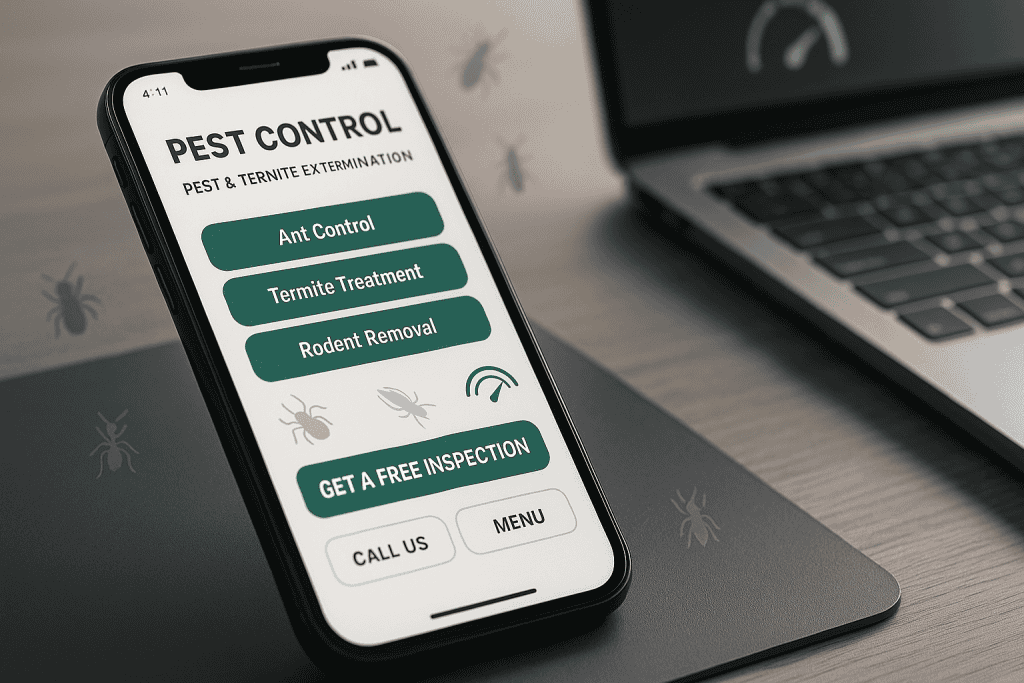
Break your services into clear, well-optimized pages such as Ant Control, Termite Treatments, Rodent Removal, Bed Bug Treatments, etc. Each page should target a specific pest, explain your approach, and highlight results or benefits.
Add an optimized service-areas page.
Create a dedicated page listing all the cities, neighborhoods, and counties you serve. Include short descriptions for each location and link to individual city pages if possible. This helps both users and Google understand your local footprint.
Use visual location badges.
Add state, region, or city badges to your homepage and service pages: for example, “Serving Northern Virginia,” “Proudly Local to Tampa Bay,” or “Greater Austin Pest Control Experts.” These visual cues build instant trust and clarity.
Pro Tip: Use Local Business Schema to Strengthen Local SEO
Adding Local Business Schema markup helps Google better understand your business details, including service type, service area, and contact information. This structured data can improve your visibility in local search, boost map rankings, and enhance your overall SEO performance.
Mistake #2: Weak or Missing Calls to Action
A call to action (CTA) is one of the most influential elements on any pest control website. It tells visitors exactly what to do next and gives them the confidence to move forward. But many pest control websites rely on vague, passive, or poorly placed CTAs, resulting in confused visitors, lower conversions, and lost revenue.
The truth is simple:
If your website doesn’t clearly guide people toward booking, they won’t.
Why It Hurts You
-
Confused visitors don’t convert. People need direction, especially when dealing with a stressful pest issue.
-
Low-intent CTAs result in fewer quote requests. “Contact Us” doesn’t communicate value or urgency.
-
A lack of direction causes users to bounce. Without a prominent next step, visitors leave to compare other companies.
-
Competitors with stronger CTAs win more jobs. Whoever makes it easiest to take the next step usually gets the lead.
What Strong CTAs Should Do
A high-performing CTA should:
-
Communicate immediate value (“Free Inspection,” “Same-Day Service Available”)
-
Reduce emotional friction (“No Obligation,” “Fast Response”)
-
Highlight the benefit (solving their pest problem quickly)
-
Match the urgency of the situation
Examples of Strong, High-Converting Pest Control CTAs
-
Get a Free Inspection
-
Request Same-Day Service
-
Schedule Your Pest Evaluation
-
Stop the Infestation Today
-
Get Your Custom Treatment Plan
-
Speak With a Technician Now
These CTAs create clarity, confidence, and urgency: all essential in the pest control buying journey.
Where to Place CTAs for Maximum Conversions
Strategic placement matters just as much as wording:
-
Hero section (top of homepage): This is where most visitors decide if they’ll stay or leave.
-
After each major content block: Especially service overviews, trust sections, or process explanations.
-
Sticky mobile footer CTA: A tap-to-call bar dramatically increases mobile conversions.
-
Bottom of every page: Capture visitors after they finish consuming content.
Pro Tip: Match the CTA to Buyer Intent
Not all visitors are ready to book immediately. Use a mix of CTAs:
High-intent:
-
“Book Same-Day Service”
-
“Get a Free Quote”
Medium-intent:
-
“See How Our Treatments Work”
-
“View Pricing Options”
Low-intent:
-
“Learn About Termites”
-
“Explore Our Pest Library”
This layered approach captures leads at all stages of the buying journey.
Mistake #3: Slow Load Speed and Poor Mobile Experience
More than 70% of people searching for pest control services are doing so on their phones, often while stressed, frustrated, or dealing with an active infestation. If your website loads slowly, glitches, or feels hard to use on mobile, you lose the lead instantly.
A fast, mobile-friendly website isn’t optional anymore… it’s a requirement for ranking well, building trust, and converting high-intent visitors.
Why It Hurts You
-
Google penalizes slow websites. Slow load times directly impact your SEO and visibility in local searches.
-
Mobile users abandon pages in under three seconds. Your visitors won’t wait, they’ll just call the next company in search results.
-
A sluggish website signals unprofessionalism. If your site feels outdated, users assume your service will be too.
-
Poor mobile layouts hurt conversions. Tiny buttons, misaligned menus, broken forms, and cluttered sections drive visitors away.
-
It damages first impressions. Your website is often the first encounter someone has with your brand, speed and usability create immediate credibility.
How to Fix It
Improving load speed and mobile usability is one of the fastest ways to increase conversions.
Performance Improvements
-
Compress images especially before/after galleries, header banners, and service photos.
-
Remove unnecessary plugins that slow the backend.
-
Use lightweight, mobile-responsive themes designed for speed.
-
Enable caching and lazy loading to reduce initial load time.
-
Add a Content Delivery Network (CDN) to deliver content faster across regions.
-
Minimize JavaScript and remove unused code to clean up your site’s performance.
-
Use next-gen formats like WebP for faster, high-quality visuals.
Mobile Experience Enhancements
-
Ensure buttons are large, thumb-friendly, and high-contrast.
-
Make phone numbers tap-to-call for quick action.
-
Simplify menu items for easier navigation.
-
Use short, mobile-friendly forms with minimal fields.
-
Test on real devices (iOS + Android), not just desktop previews.
Additional Best Practices
-
Keep videos under 1MB or replace them with optimized loops.
-
Avoid intrusive popups that disrupt the mobile experience.
-
Ensure text is readable without zooming.
-
Place primary CTAs above the fold on mobile.
External Resources
-
Google PageSpeed Insights: Analyze performance and get improvement suggestions
-
GTmetrix: Deep diagnostic breakdowns of performance bottlenecks
Mistake #4: No Trust Builders-Reviews, Credentials, Guarantees
Pest control is one of the most trust-sensitive service industries. Customers aren’t just buying a treatment; they’re inviting technicians into their homes, relying on your expertise for their family’s health and safety, and spending money to solve a stressful, sometimes urgent problem.
If your website does not immediately communicate credibility, professionalism, and proof of effectiveness, visitors hesitate… and hesitation kills conversions.
A website without strong trust builders makes customers subconsciously wonder:
-
“Can I trust these people?”
-
“Do they really know what they’re doing?”
-
“Will they keep my home safe?”
-
“Why should I choose them over the next company?”
Your website must answer those questions before the visitor even asks.
Why It Hurts You
-
Visitors question your credibility. If your site looks generic, empty, or outdated, users assume your service is too.
-
Weak trust signals reduce conversions. Even highly motivated buyers hesitate without reassurance.
-
Competitors with stronger trust elements win more jobs. The company that looks most legitimate often gets the call first.
-
A lack of transparency creates fear. Pest issues already elevate stress; customers won’t risk choosing a company that feels uncertain or unproven.
-
Modern buyers rely heavily on visual proof. Reviews, certifications, and real photos dramatically influence decision-making.
How to Fix It
Strengthen your website with clear, authentic trust builders that make visitors feel instantly confident choosing your company.
High-Impact Trust Elements to Add
-
Review widgets
Display real Google, Yelp, or Facebook reviews directly on your site with star ratings and timestamps. -
Before/after photos
Visual proof of your treatments builds competence and credibility faster than text ever will. -
Certification badges
Include licensing, insurance, NPMA membership, technician training badges, and safety certifications. -
Guarantees and warranties
Simple statements like “Satisfaction Guaranteed” or “30-Day Re-Service Guarantee” reduce buyer anxiety. -
Team photos and profiles
Humanize your business—show smiling technicians, company uniforms, trucks, and your office team. -
Case studies or success stories
A short explanation of a real customer issue + before/after + the outcome works wonders. -
Industry affiliations and partnerships
Even small badges or associations add authority.
Why These Elements Work
Trust builders increase conversions because they:
-
Overcome fear and uncertainty
-
Provide social proof
-
Demonstrate real experience
-
Differentiate you from low-quality competitors
-
Help customers visualize a safe, successful outcome
Most importantly… they make your company feel real.
Bonus Tip
Video testimonials increase conversions by up to 40%.
They create emotional connection, authenticity, and confidence. Even a simple smartphone-shot testimonial is powerful.
Mistake #5: Thin or Generic Pest Control Content
Content is one of the most powerful tools a pest control company has; yet it’s also one of the most commonly neglected. Many websites rely on generic one-paragraph service descriptions, copy-and-paste pest explanations, or vague “we can help” statements.
But modern customers, and Google, expect far more.
When someone searches for a pest control company, they’re usually stressed, uncertain, and trying to make a fast but informed decision. If your website doesn’t clearly educate them, answer their questions, or prove your expertise, they won’t give you their trust—or their business.
At the same time, Google ranks websites based on relevance, authority, and depth. Thin content fails on all three.
Why It Hurts You
-
Google prioritizes detailed, authoritative content. Thin pages don’t rank well, meaning fewer visitors and fewer leads.
-
Customers want to understand the pest threat. People dealing with infestations want reassurance and clear explanations.
-
Generic content doesn’t answer real questions. If your site can’t provide solutions, users quickly bounce to a competitor.
-
Weak content makes your business forgettable. Anyone can say “we’re professional and reliable” but real expertise stands out.
-
Short pages signal low expertise. Customers equate thoroughness with competence and safety.
What Strong Content Should Include
To stand out and rank higher, your content needs to be:
-
Educational: teaching customers about pests and your process
-
Local: referencing the region and challenges unique to your service area
-
Detailed: answering the questions customers are afraid to ask
-
Action-driven: leading users toward booking, calling, or requesting service
Here are the key content types every pest control site should have:
1. Pest Identification Guides
Explain:
-
What the pest looks like
-
Signs of infestation
-
Where pests hide
-
Health/property risks
This builds authority and helps customers self-diagnose their issue.
2. “What to Expect During Treatment” Pages
These pages dramatically reduce fear and uncertainty. Include:
-
How your treatment works
-
How long it takes
-
Safety precautions
-
What customers should do before and after
Clear expectations = higher bookings.
3. Prevention Tips
Sharing actionable advice demonstrates expertise and builds trust. It also increases site engagement, which boosts SEO.
4. FAQs for Each Pest Type
Every pest has unique worries. Answer questions like:
-
“Is this treatment safe for kids and pets?”
-
“How long does it take to work?”
-
“Will the pests come back?”
-
“How much does treatment cost?”
These are often the final barriers between a visitor and a booking.
5. Seasonal Pest Insights
Show that you understand local pest trends and stay proactive.
6. Detailed Service Pages
Each pest or service deserves its own optimized, well-written page.
No more “one paragraph for everything.”
Depth = expertise = conversions.
Internal Linking Strategy
Internal linking is one of the most underrated SEO boosters.
It helps:
-
Guide visitors deeper into your site
-
Improve topical authority
-
Increase time on page
-
Lead customers toward high-intent conversions
For example:
-
Pest ID pages → link to the related service page
-
Prevention tips → link to treatment options
-
FAQs → link to “Request a Free Inspection”
-
Blog posts → link to cornerstone guides
Internal linking creates a smooth user journey and strengthens search visibility.
Mistake #6: Confusing Navigation or Old-School Design
Your website’s navigation and design directly affect how quickly visitors can find what they need, and whether they stay long enough to become leads. In pest control, where customers are already stressed or overwhelmed, a confusing layout or outdated design can immediately push them away.
Your website should feel clean, modern, logical, and effortless to use. Anything less creates friction, and friction kills conversions.
Why It Hurts You
- Overwhelming menus create confusion. Too many choices make users freeze.
- Old designs imply outdated service. Visitors judge your professionalism instantly.
- Poor layout hides important content. Even strong information won’t matter if users can’t locate it.
- Hard-to-use mobile menus cause instant bounces. Mobile users expect simplicity and speed.
- Lack of structure breaks the user journey. If visitors can’t clearly see the steps to book, they won’t.
How to Fix It
- Simplify your navigation to key items like Home, Services, Service Areas, About, and Contact.
- Use clear dropdowns for pest categories (Termites, Rodents, Bed Bugs, etc.).
- Separate residential and commercial services so the right visitors find the right information quickly.
- Modernize your design with clean spacing, updated fonts, consistent colors, and professional photography.
- Use visual hierarchy: big headlines, bold section dividers, clear CTAs, and scannable content blocks.
- Ensure mobile navigation is flawless: large buttons, easy menus, and sticky CTAs.
Design Pro Tip
First impressions happen in 0.5 seconds. A modern, well-structured website instantly increases trust and makes your company feel more established, reliable, and professional.
Mistake #7: No Lead Capture or Follow-Up Strategy
Most pest control companies rely solely on phone calls, missing a huge portion of digital leads.
Why It Hurts You
- Missed after-hours leads
- No automated follow-up means fewer conversions
- Competitors with instant quote tools win more customers
How to Fix It
- Add a simple quote form
- Enable SMS/email auto-responses
- Offer limited-time incentives
- Use chat widgets and exit-intent popups
- Build automated follow-up sequences
Final Thoughts
Fixing these common pest control website mistakes is not just about polishing your online presence; it’s about unlocking the full revenue-generating potential of your business. Your website is often the first point of contact a customer has with your brand, which means every second, every message, and every design choice matters.
A modern, strategic pest control website does more than look good, it:
- Builds instant trust with credibility-driven content and design
- Guides visitors effortlessly toward booking a service
- Captures more leads automatically, even after business hours
- Strengthens your authority in competitive local markets
- Improves your rankings, helping you get found by high-intent searchers
When your website loads quickly, answers questions clearly, showcases expertise, and creates a seamless path to action, it transforms from a passive brochure into a 24/7 sales engine.
Whether you serve dense urban neighborhoods or spread-out rural communities, your online presence should reflect the quality, reliability, and professionalism of the services you deliver every day.
By addressing these mistakes now, you’re not just improving a website, you’re building a stronger brand, creating smoother customer experiences, and positioning your pest control company for long-term growth.
Ready to Transform Your Website Into a Lead‑Generating Machine?
If you want a website that loads faster, ranks higher, and converts more visitors into paying customers, Kiss My Grass Social is here to help.
We specialize in high‑performance SEO, content strategy, and website optimization for pest control and landscaping companies, helping service businesses dominate their local markets with ease.